Palm Beach County Loves Its Pets
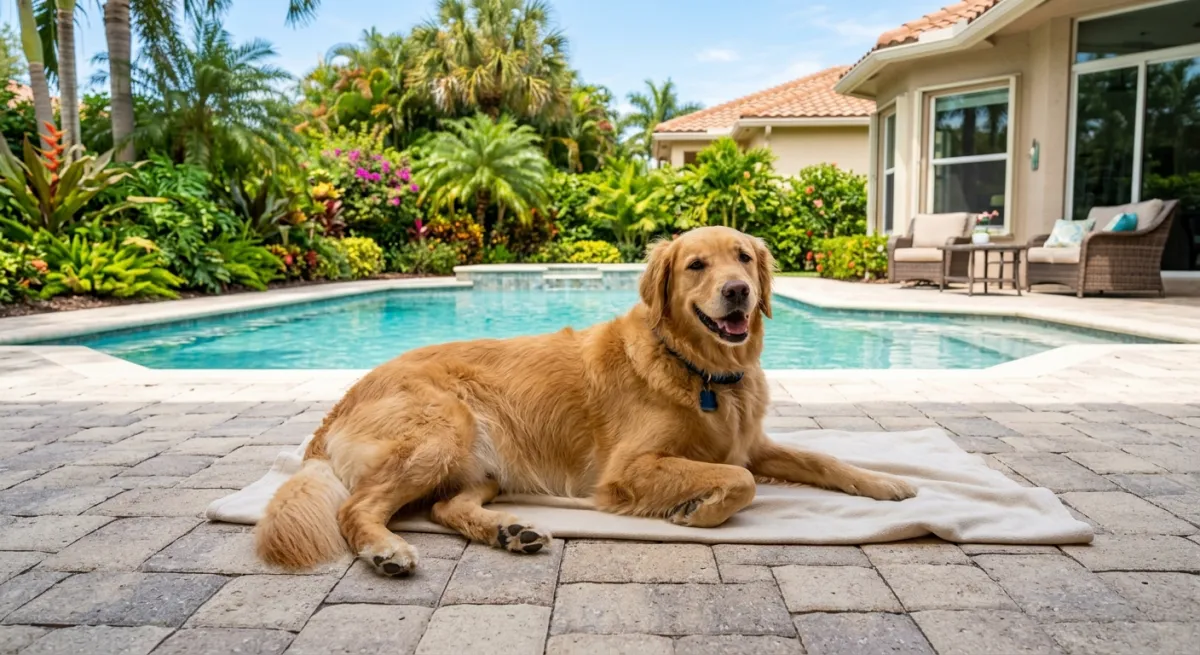
Let's start with the obvious: Palm Beach County is a dog community. Walk through any neighborhood in Palm Beach Gardens on a weekend morning and you'll see more dogs than kids. Jupiter has dog beaches. West Palm Beach has multiple dog parks. Our neighborhoods have more dog walkers than delivery drivers.
So when we show up to clean someone's home exterior, the first question is often: "Is this safe for my dog?"
It's a fair question, and it deserves a thorough, honest answer — not a quick "yeah, it's fine" and moving on. Because the truth is nuanced. Exterior cleaning chemicals can be harmful to pets if protocols aren't followed. But with proper techniques, professional exterior cleaning is not only safe for pets — it actually creates a healthier environment for them.
What Chemicals Are Used in Exterior Cleaning?
Let's pull the curtain back. There's no reason to be vague about this. Here's what's commonly used in professional exterior cleaning:
Sodium Hypochlorite (Bleach)
This is the primary active ingredient in soft washing. It's the same compound found in household bleach, but used at carefully controlled dilutions. For house washing, we typically use a 1-3% concentration (for reference, household Clorox is about 6%). For roof cleaning, the concentration might be slightly higher.
Pet concern: Concentrated sodium hypochlorite is an irritant to skin, eyes, and mucous membranes — in any animal, including humans. However, at the dilutions used in soft washing, and after the rinse process, residual concentrations on surfaces are negligible.Surfactants
These are basically soaps that help the cleaning solution spread evenly across surfaces and cling long enough to work. Most professional-grade surfactants are biodegradable and similar in composition to the soap in your dishwasher.
Pet concern: Low. Biodegradable surfactants break down quickly and don't leave harmful residues after rinsing.Sodium Hydroxide (in some applications)
Used in certain concrete cleaning applications. It's caustic at full concentration but neutralizes quickly when diluted and rinsed.
Pet concern: Moderate if concentrated, negligible after proper dilution and rinsing.What We Don't Use
Reputable exterior cleaning companies don't use:
- Acids near pet areas (except for specific stain treatments that are thoroughly neutralized)
- Toxic solvents
- Pesticide-laced cleaning agents
- Anything that requires extended "keep away" periods after application
What "Pet Safe" Actually Means
Here's where marketing gets tricky. A lot of cleaning companies (both professional and product manufacturers) slap "pet safe" on their marketing. But what does that actually mean?
It doesn't mean: You can spray the product directly on your pet with no consequences. Nothing used in exterior cleaning is safe for direct animal contact at application strength. What it should mean: When used according to professional protocols — proper dilution, appropriate dwell time, thorough rinsing — the treated surfaces are safe for pet contact after the cleaning process is complete.The key phrase is "after the cleaning process is complete." During active cleaning, when chemicals are being applied and haven't been rinsed yet, surfaces are not safe for pet contact. This is true for any cleaning product, including the ones under your kitchen sink.
How to Protect Your Pets During Exterior Cleaning
Whether you're hiring a professional or doing it yourself, these protocols protect your four-legged family members:
Before Cleaning
1. Bring all pets inside. This is non-negotiable. Dogs, cats, rabbits, tortoises — anything that roams your yard needs to be inside before cleaning begins.
2. Pick up pet toys, food bowls, and water bowls. Anything on the ground in the cleaning area should come inside. We can work around permanent features like dog houses, but loose items should be removed.
3. Note where pets typically spend time. If your dog has a favorite spot on the patio where they nap, or a section of the yard where they play, let your cleaning crew know. This helps us ensure those areas get extra-thorough rinsing.
4. Close doggy doors. If you have a pet door, close or lock it during cleaning. Curious dogs will come investigate the noise, and you don't want them walking across freshly treated surfaces.
During Cleaning
Professional crews handle this part, but if you're DIY-ing:
- Pre-wet all landscaping and grass with plain water before applying any chemicals. This dilutes any overspray and reduces absorption by plants and soil.
- Keep pets inside the entire time chemicals are being applied and during the dwell period.
- Don't let pets near the cleaning solution containers. Even diluted solutions in spray tanks are more concentrated than what ends up on surfaces.
After Cleaning
This is where the timeline question comes up: how long until pets can go back outside?
For professional soft washing with proper rinsing:
- Pool decks and walkways: Safe after thorough rinsing and when the surface is dry to the touch — typically 1-2 hours on a sunny South Florida day.
- Grass and landscaped areas: The rinse water that reaches grass is already heavily diluted. We recommend waiting 30-60 minutes after the final rinse before letting pets on the grass.
- Concrete driveways and patios: Same as pool decks — 1-2 hours after the final rinse.
The Paw-Contact Concern
The most common worry pet owners express is about their dog's paws. Dogs walk barefoot on every surface, then lick their paws. So anything on those surfaces potentially ends up ingested.
This is a legitimate concern, and here's how we address it:
Pool Decks and Patios
These are the highest-risk surfaces because dogs spend significant time on them and the surfaces hold moisture in textured finishes. Our protocol:
1. Clean with the lowest effective chemical concentration 2. Extended dwell time means we can use lower concentrations (the extra time compensates for reduced strength) 3. Multiple rinse passes — at least two full rinse cycles on pool decks 4. Final rinse with high-volume, low-pressure water to flush residue from textured surfaces
After this process, chemical residue on the surface is at or near background levels (equivalent to what's already in your pool water or tap water).
Walkways and Grass Borders
The transition zone between hardscapes and grass is important because dogs walk across both. Overspray and runoff from cleaning hardscapes inevitably reaches grass borders. Our approach:
- Pre-wet grass borders before cleaning adjacent hardscapes
- Direct rinse water away from pet-use areas when possible
- Final rinse includes flushing the grass border areas
Why Soft Wash Is Safer Than Pressure Washing for Pet Owners
This is a point most people don't consider. Soft washing uses chemical cleaning action (cleaning solutions do the work) rather than mechanical force (blasting with high pressure). That means:
- We use lower chemical concentrations than you might expect — the surfactant-based solutions are designed to work at lower strengths with longer dwell times
- The thorough rinse process is built into soft washing methodology; it's not optional, it's core to the technique
- There's less splash and overspray compared to high-pressure washing, which atomizes water and chemicals into a mist that travels further
DIY Products: Pet Safe vs. Marketing Claims
If you're doing any exterior cleaning yourself, be cautious about product claims. Here's what we've observed:
Products That Are Genuinely Lower-Risk for Pets
- Oxygen bleach (sodium percarbonate) — breaks down into washing soda and oxygen. Much less irritating than chlorine-based products.
- Enzyme-based cleaners — use biological enzymes to break down organic matter. Generally very low toxicity.
- Vinegar-based solutions — safe but limited in effectiveness on heavy biological growth.
Products Where "Pet Safe" Is Misleading
- "Pet safe" mold and mildew sprays that still contain sodium hypochlorite — it's the same chemical at the same concentration as non-"pet safe" versions, just with better marketing.
- Concentrated all-purpose cleaners marketed for outdoor use — read the actual safety data sheet, not the front label.
- Any product that says "keep away from pets until dry" — that phrase means it's not safe during application, which is true of almost everything. The question is whether it's safe after drying, and "until dry" is vague.
The Ironic Truth About DIY vs. Professional
Here's something most homeowners don't realize: professional soft wash chemicals, properly applied and rinsed, are often safer for pets than store-bought products used by homeowners.
Why? Because professionals:
- Know the correct dilution ratios (homeowners often over-concentrate, thinking more is better)
- Have equipment that applies solutions evenly (no puddles of concentrated product)
- Follow a thorough rinse protocol (homeowners often skip this or do it inadequately)
- Use professional-grade surfactants that rinse cleaner than consumer products
What About Cats?
Cats deserve a specific mention because they're more sensitive to certain chemicals than dogs, particularly to phenol-based compounds and essential oils. The good news: standard soft wash solutions (sodium hypochlorite and surfactants) are not phenol-based.
However, cats are also more likely to lick surfaces they walk on and more likely to have skin reactions from chemical contact. The same protocols apply — keep cats inside during and for a couple hours after cleaning — but be especially diligent about the timeline with cats.
Fish Ponds and Koi
If you have an outdoor fish pond or koi pond, this is actually a bigger concern than dogs or cats. Fish are extremely sensitive to sodium hypochlorite, even at low concentrations. A small amount of overspray or runoff into a koi pond can be fatal.
If you have a fish pond anywhere near the cleaning area:
- Cover it completely before cleaning begins
- Ensure no runoff flows toward the pond
- Let your cleaning crew know about it before they start — experienced professionals will adjust their approach
The Healthier Environment Angle
Here's the flip side that often gets overlooked: a home with mold, mildew, and algae growing on exterior surfaces isn't great for pets either.
Dogs that lie on mold-covered pool decks, walk through algae-slicked walkways, and play in yards adjacent to mildewed walls are exposed to those biological irritants daily. Mold spores are an allergen for dogs just as they are for humans. Algae-slicked surfaces are a slip hazard for older dogs with mobility issues.
A clean exterior isn't just visually better — it's a healthier environment for everyone in the household, including the four-legged members.
Our Approach at Crouching Tiger
We're pet owners ourselves — we get it. Every job we do in Palm Beach Gardens, Jupiter, and across Palm Beach County follows our pet safety protocol:
- We ask about pets during the estimate process
- We use the lowest effective chemical concentrations
- Pre-wetting landscaping and grass is standard, not optional
- Multiple rinse passes on all surfaces
- We communicate clearly about when it's safe for pets to return outdoors