The Invisible Danger Under Your Feet
Here's a statistic that should get every Florida homeowner's attention: slip and fall accidents are one of the leading causes of emergency room visits in the United States, and outdoor surfaces are responsible for a significant percentage of those falls. In South Florida, where outdoor surfaces are wet from rain, pool splash, or irrigation for months on end, the risk is even higher.
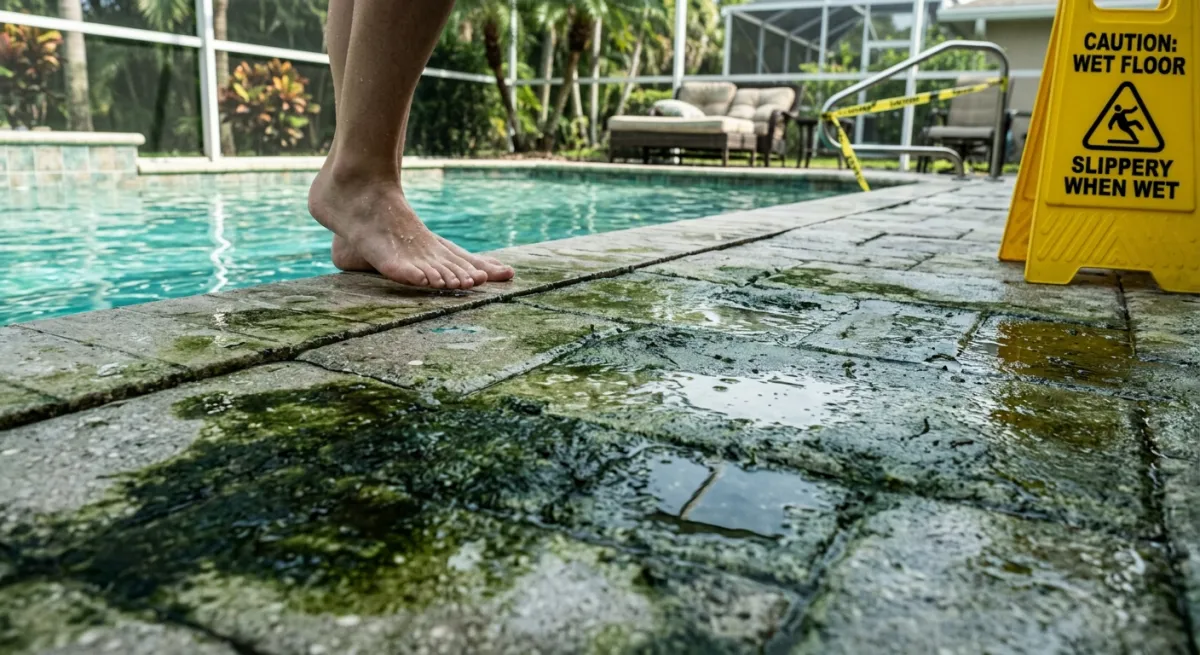
The culprit in most outdoor slip-and-fall incidents isn't water alone. Water on a clean surface creates some risk, sure. But water on an algae-covered surface creates a hazard that can send someone down without warning. That thin biofilm of green or black algae reduces friction to almost nothing, and when combined with bare feet, wet skin, and a surface that slopes toward a pool or step-down -- people get hurt.
We see it every summer in Palm Beach Gardens, Jupiter, and West Palm Beach: homeowners who didn't realize how slippery their pool deck had become until someone went down. Let's talk about prevention before that happens.
Why Florida's Wet Season Creates a Unique Problem
Most of the country gets rain intermittently. A storm passes through, things get wet, things dry out, and life goes on. South Florida's wet season is fundamentally different.
From roughly mid-May through mid-October, outdoor surfaces in Palm Beach County experience:
- Daily afternoon rain showers that keep surfaces wet for hours
- High humidity that slows evaporation even when it's not actively raining
- Morning dew that forms on surfaces overnight and doesn't fully evaporate before afternoon rain starts again
- Elevated temperatures that accelerate biological growth
By July, a pool deck that was professionally cleaned in March can have enough algae growth to be genuinely dangerous.
Which Surfaces Are Most Dangerous?
Not all outdoor surfaces are equally hazardous when algae-covered and wet. The danger level depends on the surface texture, the amount of algae present, and how the surface is used.
High-Risk Surfaces
Smooth or sealed concrete near pools -- This is the most dangerous combination. Smooth concrete that was sealed or finished with a slick surface provides very little grip when wet, and when algae fills in whatever texture exists, it becomes extremely slippery. Pool decks with a smooth finish are the #1 surface where we see slip incidents. Natural stone (marble, smooth travertine) -- Beautiful but potentially treacherous when wet and algae-covered. Polished or honed natural stone has very low natural friction, and algae reduces it further. Painted concrete -- Paint fills in the porous texture of concrete that normally provides grip. When algae grows on painted concrete and it gets wet, friction drops dramatically. Glazed tile -- Sometimes used on pool deck accents, steps, or outdoor kitchen areas. Glazed tile and water are already a bad combination; add algae and it's dangerously slick.Moderate-Risk Surfaces
Textured concrete -- Broom-finished or textured concrete provides more grip than smooth, but algae in the textured grooves still reduces friction significantly. This is the most common pool deck surface in Palm Beach County, and it still becomes hazardous when algae-covered. Pavers -- The joints between pavers provide some natural grip and drainage, and the textured surface of most pavers helps. But the flat face of each paver can still become slippery with algae growth, especially if the pavers have been sealed with a glossy sealer. Stamped concrete -- The stamped pattern provides some texture, but the surface within each stamp tends to be relatively smooth. Algae fills in the shallow texture and creates a slippery surface.Lower-Risk (But Not Zero-Risk) Surfaces
Exposed aggregate concrete -- The embedded stone aggregate provides excellent texture and grip, even when wet. Algae has a harder time forming a continuous film over the rough surface. This is one of the best pool deck surfaces for wet-weather traction. Textured coatings (Kool Deck, spray texture) -- These applied coatings are specifically designed for pool deck safety and provide good wet traction. However, heavy algae growth can still reduce their effectiveness. Shell rock or coral stone -- Naturally rough and porous, these materials maintain good grip even when wet. They're less commonly used for formal pool decks but excellent for walkways and informal outdoor areas.The Liability Factor: What Homeowners Need to Know
This is the part that makes most people pay attention. In Florida, premises liability law holds property owners responsible for maintaining safe conditions on their property. If someone is injured on your property due to a hazardous condition that you knew about (or should have known about), you can be held liable.
What This Means for Homeowners
- If a guest slips and falls on your algae-covered pool deck, you could be legally and financially responsible for their injuries
- Homeowner's insurance typically covers premises liability claims, but your premiums will increase after a claim -- and severe injuries can exceed policy limits
- The legal standard isn't whether you intentionally made the surface dangerous -- it's whether you knew or should have known the condition existed and failed to address it
- In Palm Beach County, where algae growth on outdoor surfaces is universal and well-documented, arguing that you "didn't know" the surface was slippery is a tough sell
What This Means for Commercial Property Owners
For businesses, the stakes are even higher:
- Restaurants and hotels with outdoor dining or pool areas have a duty to maintain safe walking surfaces
- HOAs and property management companies are responsible for common areas, walkways, and shared pool decks
- Retail properties with outdoor walkways and parking areas face slip-and-fall claims regularly
- Documentation of regular cleaning and maintenance is your best defense in a liability claim
Prevention: A Multi-Layer Approach
Keeping outdoor surfaces safe during Florida's wet season requires more than one strategy. Here's the comprehensive approach:
Layer 1: Regular Pressure Washing
This is the foundation of outdoor slip prevention. Professional pressure washing removes algae biofilm entirely, restoring the surface's natural texture and friction.
How often during wet season?The frequency depends on the surface and its exposure:
| Surface | Recommended Frequency (May-October) |
|---|---|
| Pool deck (high traffic) | Every 2-3 months |
| Main walkways | Every 3-4 months |
| Patio/lanai floor | Every 3-4 months |
| Driveway | Every 4-6 months |
| Secondary walkways | Every 6 months |
For high-risk areas like pool decks, more frequent cleaning during summer is a safety investment, not a luxury.
Layer 2: Anti-Slip Sealers
After pressure washing, applying an anti-slip sealer can significantly improve wet traction on concrete and paver surfaces. These sealers contain fine aggregate particles (like silica or polymer beads) that create microscopic texture on the surface.
Benefits:- Increases friction even when the surface is wet
- Protects the surface from staining and biological growth (slowing regrowth)
- Enhances the appearance of concrete and pavers
- Lasts 1-3 years depending on traffic and exposure
Layer 3: Textured Coatings
For surfaces that are inherently slippery (smooth concrete, for example), a textured coating can be applied to permanently improve traction. Products like Kool Deck, acrylic texture coatings, or rubberized deck coatings add substantial grip to otherwise smooth surfaces.
These are more of a renovation than a maintenance step, but for pool decks with a known slip problem, they're worth considering.
Layer 4: Drainage Improvements
Standing water is worse than flowing water when it comes to slip risk. If areas of your pool deck, patio, or walkway hold puddles after rain, improving drainage reduces how long surfaces stay wet.
Options include:- Regrading to direct water toward drains or landscape areas
- Adding drainage channels (trench drains) in problem areas
- Installing permeable pavers that allow water to pass through
- Adjusting downspout placement so gutter discharge doesn't flow across walking surfaces
Layer 5: Immediate-Action Steps
While you're planning professional cleaning and longer-term solutions, here are things you can do right now:
- Place non-slip mats at pool entry/exit points and at the base of steps
- Add adhesive non-slip strips to high-traffic areas, especially steps
- Keep a squeegee or push broom near the pool to clear standing water from the deck
- Install grab bars near pool steps and raised areas
- Ensure outdoor lighting is adequate so people can see where they're walking after dark
The Pool Deck Problem: A Special Focus
Pool decks deserve extra attention because they combine every risk factor:
- Constant moisture from pool splash, rain, and irrigation
- Bare feet with no tread or grip from shoes
- Wet skin that's more slippery than dry skin
- Running (kids, mainly, but adults too)
- Chemical residue from pool water that can leave slippery films
- Varied surfaces where the deck meets coping, steps, or the pool edge
Don't Wait for an Accident
The worst time to think about slip prevention is after someone gets hurt. A fall on a hard surface can mean broken bones, head injuries, spinal damage, or worse. For elderly visitors or young children, the consequences can be severe.
Walk outside right now and look at your pool deck, your patio, your walkway to the front door. Run your hand across the surface. If it feels slimy, if you can see green or black film, if your feet slide when the surface is wet -- it's time to act.
Get your free quote for a safety-focused exterior cleaning. We'll address every walking surface on your property, remove dangerous algae buildup, and discuss anti-slip treatment options to keep your family and guests safe through the rest of wet season. Your pool deck should be a place for fun, not a trip to the emergency room.