The Numbers Don't Lie
If you live in Palm Beach County, you already know August feels brutal. But the data backs up what your body is telling you — August is the single worst month for exterior mold growth in our area, and it's not even close.
Here's why, by the numbers:
- Average humidity: 77-82% (often exceeding 90% at night)
- Average overnight low: 77°F (surfaces never cool enough to dry)
- Average rainfall: 8+ inches (the wettest month of the year, tied with September)
- Consecutive months of high moisture: This is month three or four of rainy season
- UV index: Still extreme, but cloud cover from daily storms reduces surface drying time
Why Mold Growth Is Exponential, Not Linear
This is the part most homeowners don't understand, and it's the reason August is so much worse than June.
Mold doesn't grow at a steady rate. It compounds. Think of it like interest on a credit card — the balance doesn't just increase, it increases faster and faster.
Here's How the Summer Progression Works
Late May / Early June: Rainy season begins. Your home's surfaces are relatively clean from spring. Mold spores land on damp surfaces and begin to germinate. Growth is slow because the colonies are just establishing. July: The colonies from June are now mature and producing their own spores. These spores land on adjacent surfaces and start new colonies. You now have dozens of growth points instead of a handful. The moisture has been constant for six weeks, so surfaces are thoroughly saturated. August: Every colony from June and July is now fully mature and producing spores at maximum rate. New colonies are establishing on top of existing growth. The surfaces have been wet for three solid months. Nutrients from organic debris (pollen, leaf matter, insect residue) have been accumulating all summer, giving mold plenty of food. The result: What was barely visible in June is now thick, established, deeply rooted mold covering large sections of your home. August doesn't just add to July's problem — it multiplies it.A Simple Way to Visualize It
Imagine you put a single grain of rice on a chessboard square, then doubled it for each square:
- Square 1: 1 grain
- Square 2: 2 grains
- Square 10: 512 grains
- Square 20: 524,288 grains
Which Surfaces Are Most at Risk Right Now
Not every surface on your home is equally vulnerable. Here's the risk ranking for August in Palm Beach County:
Critical Risk: North-Facing Stucco and Siding
North-facing walls get the least direct sunlight. In August, these surfaces might stay damp for 20+ hours per day — morning dew, afternoon rain, evening humidity, overnight moisture. Mold thrives here because the surface literally never dries out.
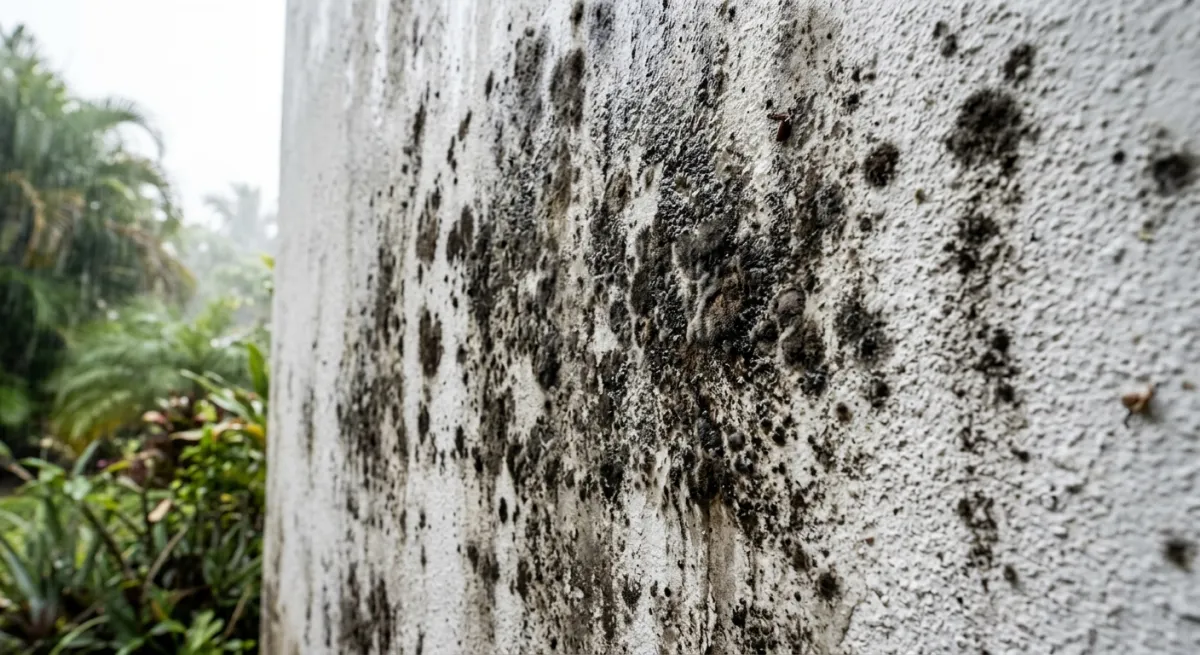
What you'll see: Black or dark green patches, often starting at the base of the wall and creeping upward. The growth may have a fuzzy or slimy texture depending on the species.High Risk: Pool Decks and Concrete Flatwork
Horizontal surfaces collect and hold water longer than vertical ones. Your pool deck, patio, and walkways have been sitting in moisture all summer. Add foot traffic grinding organic matter into the porous surface, and you've got a mold buffet.
What you'll see: Dark discoloration, especially in shaded areas and along edges where water pools. The surface may feel slippery when wet — that's a biofilm of algae and mold, and it's a serious slip hazard.High Risk: Roof Tiles and Shingles
Your roof has been taking the full force of every rainstorm since May. The north-facing slope is almost certainly showing dark streaks by now. Flat or low-slope roof areas where water pools are especially vulnerable.
What you'll see: Dark streaks running from ridge to eave (Gloeocapsa Magma algae), green patches in low spots, and possible moss growth in heavily shaded areas.Moderate Risk: Fences, Retaining Walls, and Hardscape
These often-forgotten surfaces are showing significant growth by August. Wooden fences are especially vulnerable — the mold isn't just growing on the surface, it's penetrating the wood fibers and causing structural decay.
What you'll see: Green and black growth on fence boards, discoloration of retaining wall blocks, algae in the joints of paver patios.Moderate Risk: Gutters, Soffits, and Fascia
Water flowing off your roof carries mold spores directly to these surfaces. Clogged gutters create standing water — essentially a mold incubator attached to your house.
What you'll see: Black streaking below the gutter line ("tiger striping"), mold spots on soffit panels, discoloration of fascia boards.The Health Implications of Peak-Level Exterior Mold
"It's just on the outside of the house. How bad can it be?"
Worse than you think.
Outdoor Air Quality Impact
When mold colonies reach the density typical of August in South Florida, they're releasing millions of spores into the air around your home every day. These spores don't stay outside — they enter your home through:
- Doors and windows (even when closed, spores infiltrate gaps)
- Your HVAC system (the outdoor unit pulls in surrounding air)
- Your clothing and shoes (you carry spores inside)
- Pet fur (dogs and cats are excellent spore transporters)
Who's Most Affected
Exterior mold at August levels is a particular concern for:
- Children — their respiratory systems are still developing, and they breathe faster (inhaling more spores per body weight)
- Elderly residents — compromised immune function makes mold-related illness more likely
- Allergy sufferers — if your allergies are worse in August, exterior mold is a major contributor
- Asthma patients — mold spores are a well-documented asthma trigger
- Anyone with respiratory conditions — COPD, bronchitis, and similar conditions are aggravated by high spore counts
Symptoms to Watch For
If anyone in your household is experiencing these symptoms and they've worsened over the summer, exterior mold exposure could be a factor:
- Persistent sneezing and runny nose
- Itchy, watery eyes
- Coughing or wheezing, especially at night
- Sinus pressure and headaches
- Skin irritation or rashes
- Fatigue that doesn't improve with rest
Why Waiting Until October Is a Mistake
The most common thing we hear in August is: "I'll wait until after hurricane season to get everything cleaned." We understand the logic — why clean now if a storm might mess things up again?
Here's the problem with that thinking:
Two More Months of Exponential Growth
Remember the compounding effect we discussed? If August is bad, September and October are devastating. You're not adding two months of growth — you're multiplying it. What costs $400 to clean in August might cost $600 or more by October because the mold has penetrated deeper and is harder to remove.
Surface Damage Is Happening Now
Mold isn't just sitting on top of your surfaces — it's actively degrading them:
- Stucco: Mold produces acids that break down the cement binder
- Concrete: Algae and mold etch the surface, creating permanent discoloration
- Wood: Mold penetrates wood fibers, causing structural weakness
- Paint: Mold growing beneath paint causes bubbling, peeling, and premature failure
- Pavers: Mold and algae destabilize joint sand, leading to shifting and settling
Your Health Doesn't Wait
The spores affecting your family's air quality don't care about your cleaning schedule. If outdoor mold is contributing to respiratory symptoms, every day matters.
Emergency Signs: You Need Cleaning NOW
Some situations can't wait for a convenient scheduling window. Call a professional immediately if you notice:
- Thick, visible mold on surfaces where you or your family walk — this is a slip-and-fall hazard and a health concern
- Mold visible around your HVAC outdoor unit — spores are being pulled directly into your home's air system
- A musty smell when you walk outside, especially near walls or in the lanai — this indicates extremely high mold concentration
- Mold on or near your front entry — guests are walking through a spore cloud to enter your home
- Roof streaking that wasn't there a month ago — rapid growth means aggressive species; early treatment prevents major damage
- Anyone in your home developing unexplained respiratory symptoms — reduce exterior mold load as a first step
The Mid-Summer Intervention Strategy
If you've been waiting for fall, consider this instead: a mid-summer intervention.
Here's why it's the smartest approach:
Break the Growth Cycle
A professional cleaning in August doesn't just remove existing mold — it resets the clock. Our soft wash treatments kill mold at the root and leave a residual that inhibits regrowth. Instead of mold compounding through September and October, you get months of protection from a single treatment.
Reduce the Fall Cleaning Burden
Even if you plan to do a full property cleaning in October, a mid-summer intervention means the fall job is faster, easier, and less expensive. You're cleaning two months of light regrowth instead of five months of compounded buildup.
Protect Your Investment Between Cleanings
Think of it like oil changes for your car. You don't wait until the engine is damaged — you maintain it on a schedule. A mid-summer cleaning protects your home's surfaces during the most aggressive growth period of the year.
What a Mid-Summer Cleaning Includes
When we do an August intervention, we focus on:
1. Full soft wash of all exterior walls — killing mold, algae, and mildew at the root 2. Pool deck and patio treatment — removing slip hazards and restoring appearance 3. Walkway and driveway cleaning — addressing the surfaces with the most foot and vehicle traffic 4. Gutter and fascia cleaning — removing the black striping and clearing debris 5. Spot treatment of fences and hardscape — targeting the worst areas
The whole process typically takes a few hours for an average Palm Beach home. You don't need to be present — just let us know you're booking, and we'll handle the rest.
Don't Let August Win
August in Palm Beach County is tough enough without mold making it worse. The humidity, the rain, the heat — you can't control any of that. But you can control what's growing on your home.
A mid-summer professional cleaning is one of the smartest maintenance decisions you can make. It protects your surfaces, improves your air quality, reduces your fall cleaning costs, and makes your home look dramatically better immediately.
Get a free quote from Crouching Tiger Exterior Cleaning today. We serve Palm Beach Gardens, Jupiter, West Palm Beach, and surrounding areas throughout Palm Beach County. Don't give mold two more months to do its damage — let's break the cycle now.