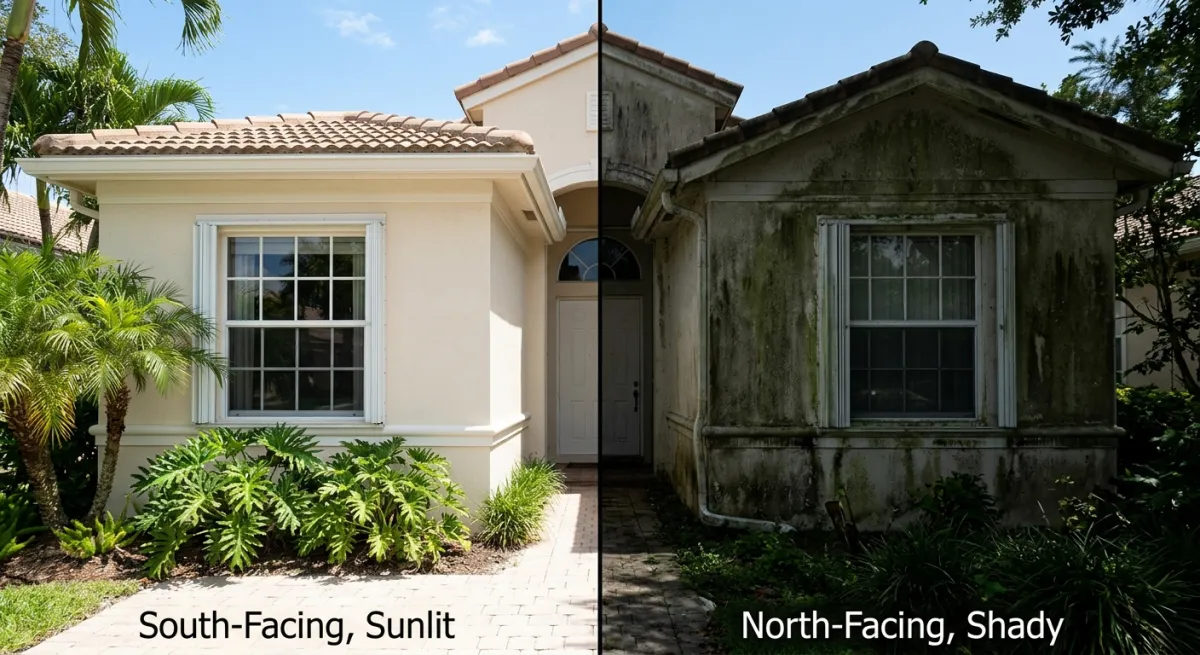
The Wall That's Always Dirty
You've seen it on your own home, and you've definitely noticed it on other houses around Palm Beach Gardens, Jupiter, and West Palm Beach. One side of the house looks relatively clean, maybe just a little dusty. Then you walk around to the other side and it's a completely different story -- dark mold stains, green algae streaks, maybe even moss starting to form.
Nine times out of ten, that dirty side faces north.
This isn't bad luck, and it's not because the wind blows more dirt against that wall. It's basic science -- and once you understand it, you'll also understand why certain parts of your property need more frequent attention than others.
The Sun Angle Explanation
Here's the key fact: in the Northern Hemisphere, the sun tracks across the southern portion of the sky. Even during South Florida's summer, when the sun is nearly overhead, it spends more time illuminating south-facing surfaces than north-facing ones.
What does this mean for your home?
South-Facing Walls
Your south-facing walls receive the most direct sunlight throughout the year. In South Florida, these surfaces get hammered with UV radiation and heat from sunrise to sunset. This has several effects:
- UV light is a natural disinfectant -- it kills mold and algae spores on contact
- Heat dries surfaces faster after rain, dew, or irrigation
- Dried surfaces don't support biological growth -- mold and algae need sustained moisture to thrive
North-Facing Walls
Now flip it. Your north-facing walls receive the least direct sunlight of any surface on your home. In fact, during winter months, north-facing walls in South Florida may receive almost no direct sun at all. Even in summer, the sunlight they receive is angled and brief.
This creates a perfect mold environment:
- Less UV radiation means fewer mold and algae spores are killed naturally
- Less heat means surfaces stay cooler and retain moisture longer
- Slower drying after rain means extended wet periods that mold needs to grow
- Lower evaporation rates keep humidity higher right at the wall surface
It's Not Just Walls
The north-side problem affects every exterior surface, not just walls:
Roofs
The north-facing slope of your roof grows algae and mold significantly faster than the south-facing slope. If you've ever looked at a roof and noticed that one side has heavy dark streaking while the other looks relatively clean, now you know why. In Palm Beach County, where Gloeocapsa Magma (the black algae that feeds on shingles) is everywhere, the north-facing roof slope is always the first to show heavy staining.
Fences
North-facing fence panels -- the side that faces south gets sun, so it's the north-facing side that stays wetter and grows mold faster. If you have a fence around your backyard, walk around and compare sides. You'll see the difference clearly.
Driveways and Walkways
Sections of concrete or pavers that are shaded from the south (by the house, by trees, by a wall) behave like north-facing surfaces. They stay damp longer and grow algae faster than exposed sections. This is why you often see heavy green growth along the north edge of a driveway where the house blocks the sun, while the center and south edge of the same driveway look relatively clean.
Pool Decks
If your pool deck has any areas shaded by the house, a screen enclosure roof, or mature trees, those areas will develop algae much faster than the sunlit portions. The north side of the pool enclosure is typically the worst offender.
The Shade Factor: Trees Make It Worse
Now layer in shade from trees, and the north-facing problem compounds dramatically.
Palm Beach County properties often have significant tree coverage -- mature oaks, tropical hardwoods, dense palm clusters. These trees provide welcome shade for human comfort, but they also:
- Block whatever limited sunlight north-facing surfaces receive
- Drop organic debris (leaves, seeds, bark) that feeds mold and algae
- Create a microclimate of higher humidity beneath the canopy
- Prevent air circulation that would otherwise help surfaces dry
Why Some Homes Need Asymmetric Cleaning Schedules
Here's where this knowledge becomes practical. If your home has significant biological growth differences between the north and south sides, it may not make sense to clean the entire house on the same schedule.
The Standard Approach
Most homeowners have their entire house washed once or twice a year. For a home with relatively even sun exposure and minimal shade, this works fine. Every wall gets cleaned at the same time, and regrowth happens at roughly the same rate.
The Smarter Approach for Uneven Homes
If your north-facing walls are consistently worse than the rest of the house, consider this approach:
- Full house wash in the spring or fall (your regular annual or semi-annual cleaning)
- Targeted north-side touchup at the midpoint between full cleanings
This approach is:
- More cost-effective than two full house washes
- More proactive than waiting for the north side to get terrible before your next full cleaning
- Better for your surfaces because heavy growth is harder to remove and more likely to leave residual staining
What You Can Do Between Cleanings
Beyond scheduling targeted professional cleaning, there are steps you can take to slow growth on north-facing surfaces:
Improve Sunlight Access
- Trim trees that shade north-facing walls, even partially. Every additional hour of direct sunlight makes a difference
- Remove or thin dense landscaping against north-facing walls
- Avoid adding shade structures (pergolas, awnings) on the north side if mold is already a problem
Improve Airflow
- Keep vegetation trimmed away from north-facing walls (at least 12-18 inches of clearance)
- Remove debris (fallen leaves, pine needles) from the base of north-facing walls regularly
- Ensure gutters on the north side are clear -- overflow onto already-damp walls makes the problem worse
Reduce Moisture
- Check irrigation -- sprinkler overspray hitting north-facing walls is a common problem that accelerates growth dramatically
- Ensure proper grading directs water away from the north foundation
- Clean gutters to prevent overflow that runs down the north wall
A Quick Experiment for Your Own Home
Want to see the north-side effect in action? Try this:
1. After your next professional house washing, take a photo of each side of your home -- north, south, east, and west 2. Set a calendar reminder for 60 days later 3. At the 60-day mark, take the same photos from the same angles 4. Compare the before and after
You'll almost certainly see that the north-facing wall has significantly more visible regrowth than the others. The south-facing wall will likely look nearly as clean as the day it was washed. East and west walls will fall somewhere in between.
This isn't abstract science -- it's happening on your home right now. Once you see the pattern, you can make smarter decisions about your cleaning schedule and where to focus your prevention efforts.
What to Do About the North Side
The north side of your home isn't dirty because you're unlucky or because something is wrong with your house. It's dirty because it gets less sun, stays wetter, and provides better growing conditions for biological contaminants. Every home in Palm Beach County deals with this -- the degree just varies based on tree coverage, building orientation, and microclimate.
Understanding this pattern lets you:
- Set realistic expectations about how quickly different surfaces will get dirty
- Make smarter scheduling decisions with targeted cleanings for problem areas
- Focus prevention efforts where they'll have the most impact
- Save money by treating the problem strategically rather than reactively